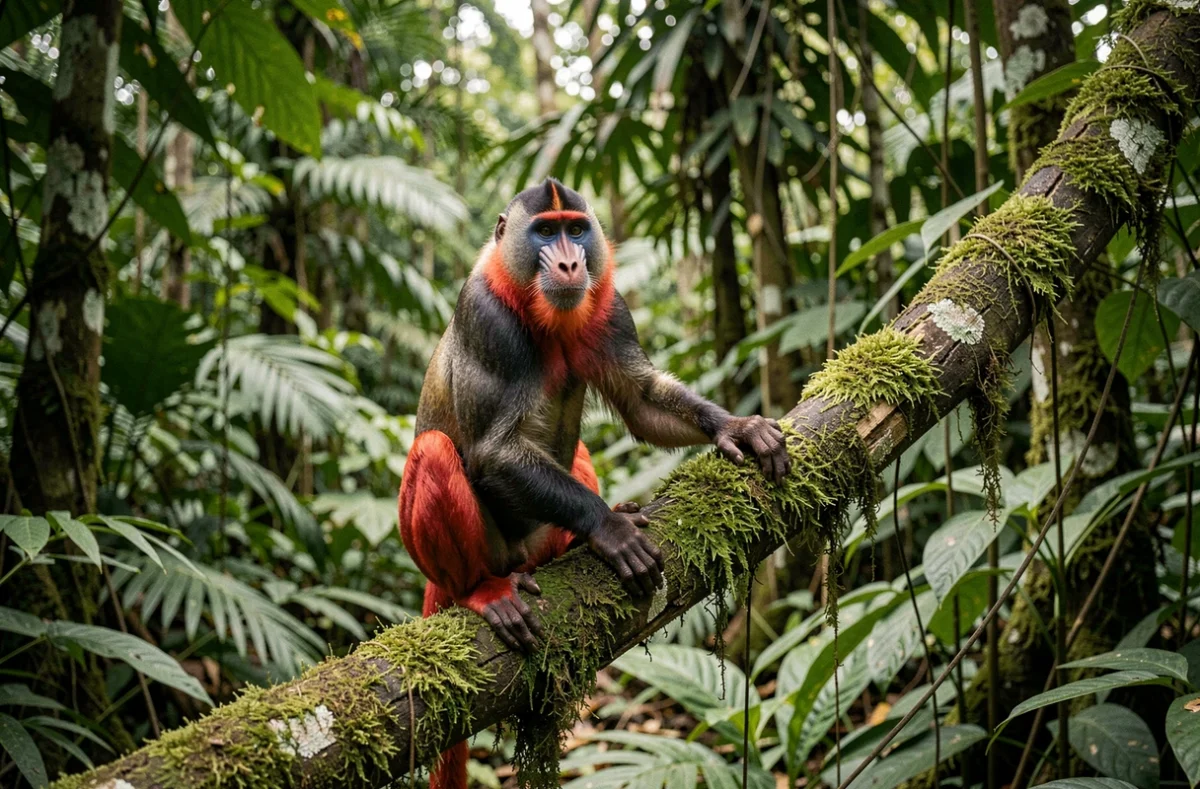
In the field, when faced with a group of dark-furred primates, it is often the colorful patch on their hindquarters that catches the eye first. The red-bottomed monkey, as it is commonly called, is not a single species: several primates share this anatomical feature, from the mandrill to the crested macaque and certain baboons.
Understanding the purpose of this coloration means looking beyond the visual curiosity to consider the interplay between sexual signaling, social hierarchy, and biological adaptation.
Red coloration in primates: a signal, not an ornament
When observing a group of mandrills in a forest habitat, the first thing that stands out is how much their colors vary from one individual to another. The bare skin on their hindquarters can range from bluish to purplish, with distinctly red areas, and the intensity varies according to the animal’s sex, age, and status.
In female mandrills, swelling and more intense coloration signal receptivity to mating. This is not a fixed trait: the colored area changes throughout the hormonal cycle, making it a dynamic indicator that males in the group can read.
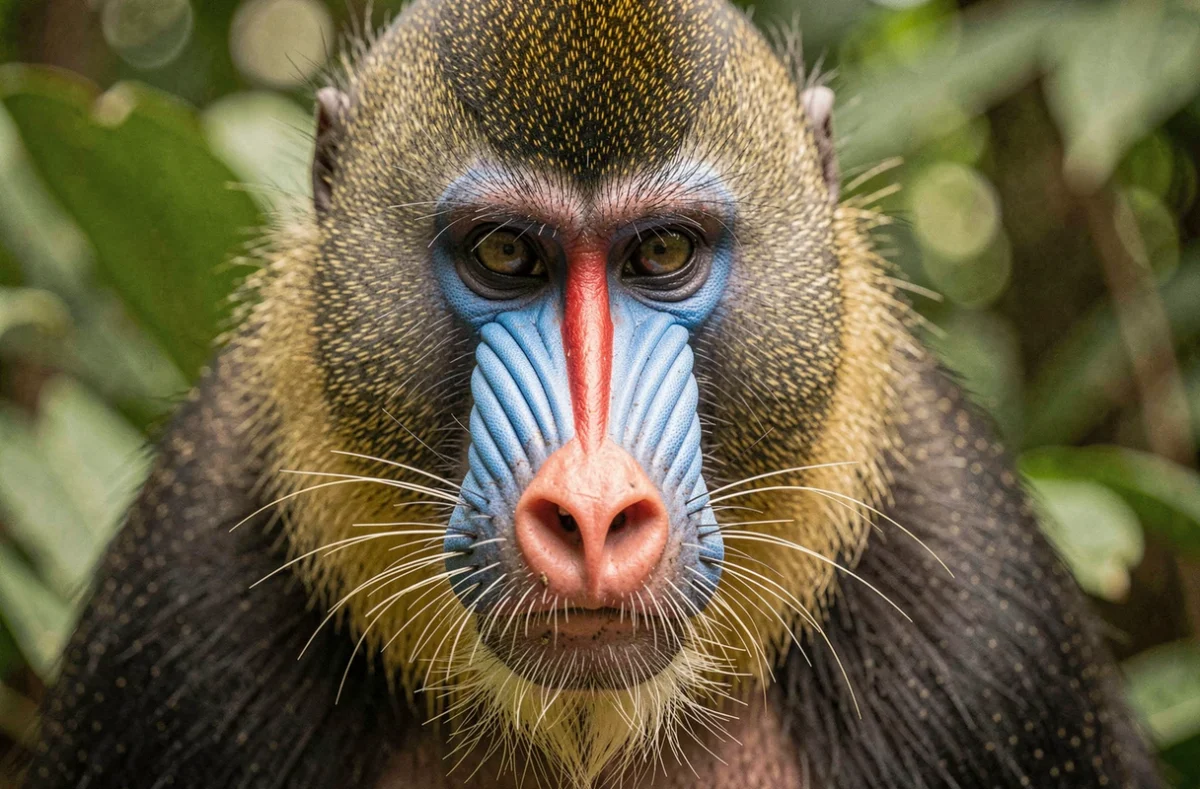
To learn more about the red-bottomed monkey and better distinguish the species involved, it is important to understand that the coloration is not limited to the hindquarters. Male mandrills also have bright red and blue markings on their faces, whose intensity varies with their social rank.
Mandrills, macaques, geladas: which species have red coloration, and where
These species are often confused because the word “red” is used too broadly. In the field, the distinctions are more precise.
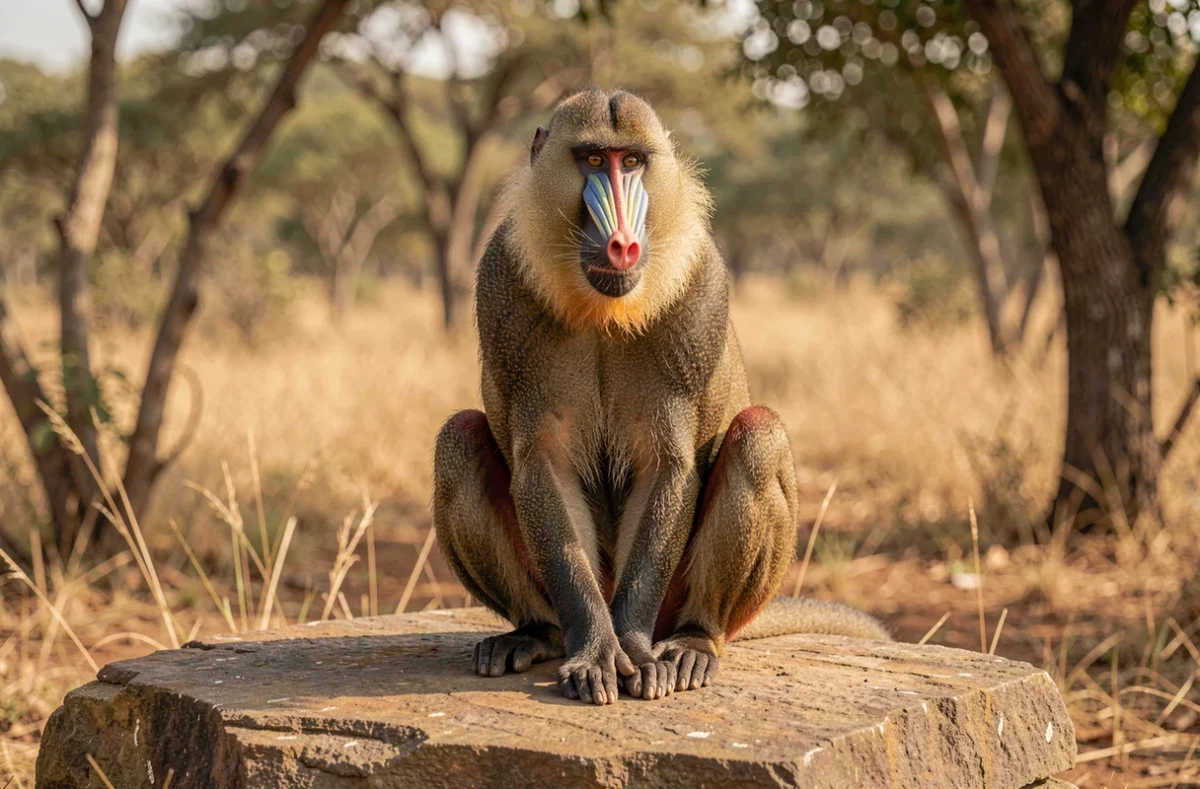
- The mandrill (Mandrillus sphinx) has vivid facial coloration (red and blue) and colorful hindquarters (bluish to purplish with red areas). Dominant males display the most intense hues.
- The Sulawesi crested macaque (Macaca nigra) has reddish to pinkish rump pads that stand out against its dark skin. Females show pronounced swelling in this area when receptive.
- The gelada (Theropithecus gelada), sometimes mistaken for a baboon, has no red coloration on its hindquarters but does have a distinctive red patch on its chest, bordered by small blisters whose appearance varies with the female’s hormonal cycle.
The gelada is a good example of the confusion: it is sometimes grouped with “red-bottomed monkeys,” even though its distinctive coloration is elsewhere. In the field, the confusion disappears as soon as you see the animal from the front.
Baboons and other borderline cases
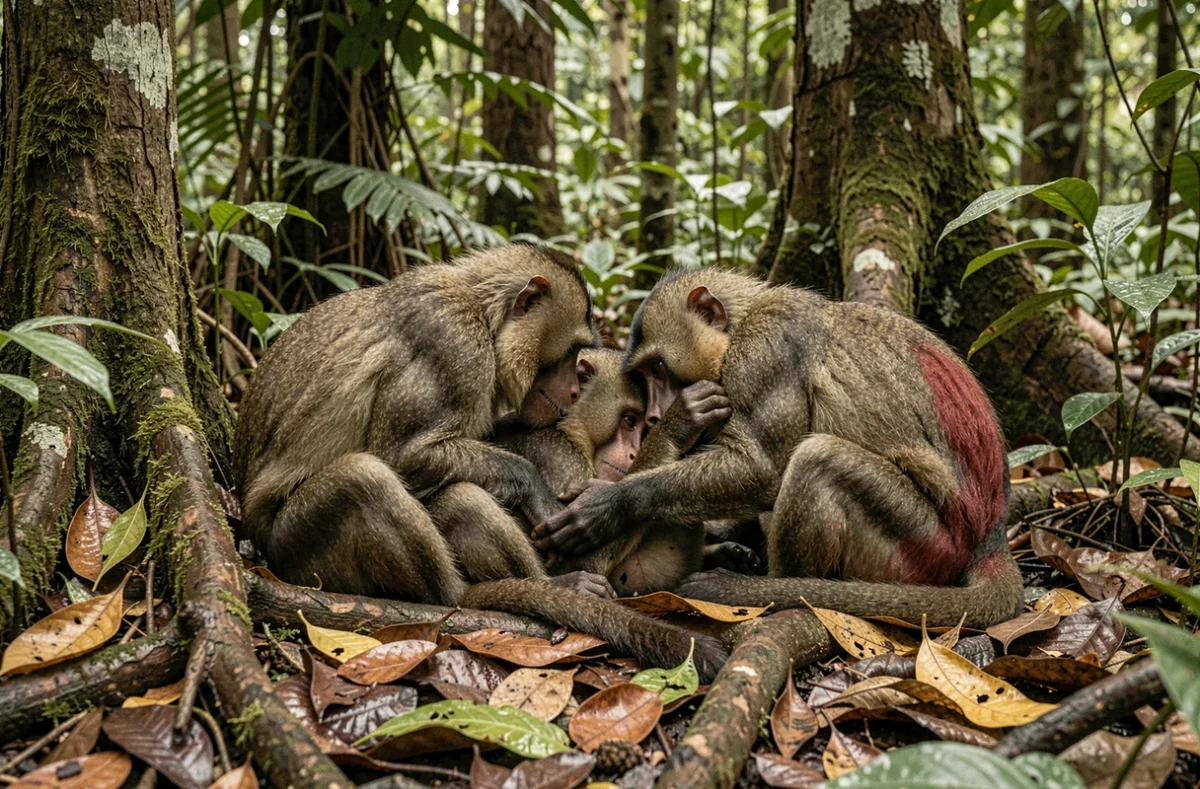
Several baboon species have pinkish to reddish rump pads, but they are rarely as striking as those of the mandrill. The coloration is subtle in adult males and becomes more pronounced in females during their fertile period. The visual signal is therefore not as strong.
Social rank and coloration: what color intensity reveals in mandrills
The link between color and hierarchical status is one of the best-documented aspects of mandrill behavior. The intensity of facial coloration directly reflects a male’s rank in the group. An alpha male displays much more vivid reds and blues than a subordinate male.
What makes this mechanism remarkable is that it is reversible. Secondary ornaments—the color of the face and, to a lesser extent, the hindquarters—change when a male gains or loses alpha status. This is not a trait fixed at birth, but a real-time indicator of social position.
This system allows other group members to assess the balance of power without physical confrontation. Coloration acts as an honest signal of dominance because it is physiologically costly to maintain: it depends on testosterone levels and the male’s overall physical condition.
Distinguishing facial signals from hindquarter signals
It would be a mistake to reduce all these colorations to a single function. In mandrills, the face and hindquarters do not convey the same information. The face signals social rank and a male’s competitiveness. The hindquarters, especially in females, communicate reproductive receptivity.
Confusing the two means overlooking the fact that each colored area plays a distinct role in the group’s social communication. Primatologists emphasize this distinction to avoid oversimplified interpretations.
Habitat and lifestyle of primates with red coloration
Mandrills live mainly in the dense tropical forests of Central Africa, particularly in Equatorial Guinea, Cameroon, and Gabon. They travel on the ground in groups of several dozen individuals, sometimes many more during seasonal gatherings.
The Sulawesi crested macaque occupies a very different habitat: the tropical forests of the Indonesian island of Sulawesi. Its range is limited, making it vulnerable to deforestation and poaching.
Geladas, meanwhile, live in the Ethiopian highlands, in high-altitude grasslands. They are the only primates whose diet consists primarily of grass. Their terrestrial lifestyle and open habitat contrast sharply with the forest-dwelling species mentioned above.
These three primates share visible red coloration, but their habitats, diets, and social structures differ radically. Grouping all “red-bottomed monkeys” under a single label obscures this biological diversity.
Red coloration in primates is neither decorative nor incidental. It is a communication tool whose location, intensity, and function vary according to species, sex, and social context. Male mandrills display their rank on their faces, female macaques signal fertility through their rump pads, and geladas bear their mark on their chests. Each pattern tells a different evolutionary story, shaped by the selection pressures of its particular environment.