
In 1855, the French press linked the inverted pentagram to black magic rituals for the first time. In several ancient traditions, this same symbol is used to represent protection and balance.
The pentagram has not always been associated with the imagery of the devil or transgression. It has traversed the centuries as a chameleon sign, changing according to the era, shifting from a protective use in medieval manuscripts, where it kept evil at bay, to a role of initiation in secret societies. It is precisely this versatility that makes the symbol still provoke misunderstandings and heated debates today.
A five-pointed star: origins and evolutions of the pentagram throughout history
Since antiquity, the pentagram has captured attention. Its five-pointed star inscribed within a pentagon has lent its lines to a thousand interpretations: for the Pythagoreans, it embodies the harmony of the cosmos, each point being a principle of life that allows recognition among initiates. Let’s forget the association with evil: the pentagram was long synonymous with balance, an alliance between body and nature, and is part of the tradition of sacred geometry.
During the Renaissance, Leonardo da Vinci seized the emblem by integrating it into the Vitruvian man. The points of the star thus extend the extremities of the human body, bringing the microcosm of the being closer to the great order of the universe. This star guides painters and scientists on the path of the golden ratio and the right proportion.
But, gradually, the symbolism wavers. Over the centuries, the star pentagram takes on another meaning. Where it once evoked health or protection, some occultists attribute a value of subversion to it. Diverted, the inverted pentacle finds its place in our societies, becoming an emblem of transgression. A shift that is not coincidental.
Indeed, the meaning of the satanic star divides and intrigues. The symbol disturbs, fascinates, and feeds the collective imagination as it navigates between science, esotericism, and thwarted passions. It is impossible to confine it to a single framework; it escapes all ready-made labels.
What symbols and meanings lie behind the pentagram?
The pentagram traverses civilizations, never fixed, always reinvented. Depending on the period or the circle in which it circulates, the five-pointed star transforms. Its “upright” version echoes the balance of forces, nature, and the ongoing dynamics between the elements.
To clarify what each branch traditionally signifies, let’s specify the usual correspondences:
- the earth
- the water
- the air
- the fire
- the spirit
The pentagram thus unites the human body and the universe in a vision where matter meets energy.
Hermetic doctrines, heirs of antiquity, see in the pentagram symbol a bulwark against undesirable influences. Alchemy reads it as the fusion of natural forces. In ritual magic, the pentacle as well as the pentagram structure the rituals, centering the practitioner’s will.
Sometimes, the pentagram is confused with the Seal of Solomon, which is rooted in the hexagram. The entire difference lies in the symbolic trajectory: the pentagram, through its five branches, evokes the constant dynamic and creative tension between matter and spirit.
The satanic pentagram, for its part, only appears after successive distortions. The inverted star, the “point down,” signifies a break with the dominant order, a deliberate desire to provoke. Yet, the representation of the pentagram constantly escapes routine: a shifting boundary between ancestral protection and the affirmation of marginality.
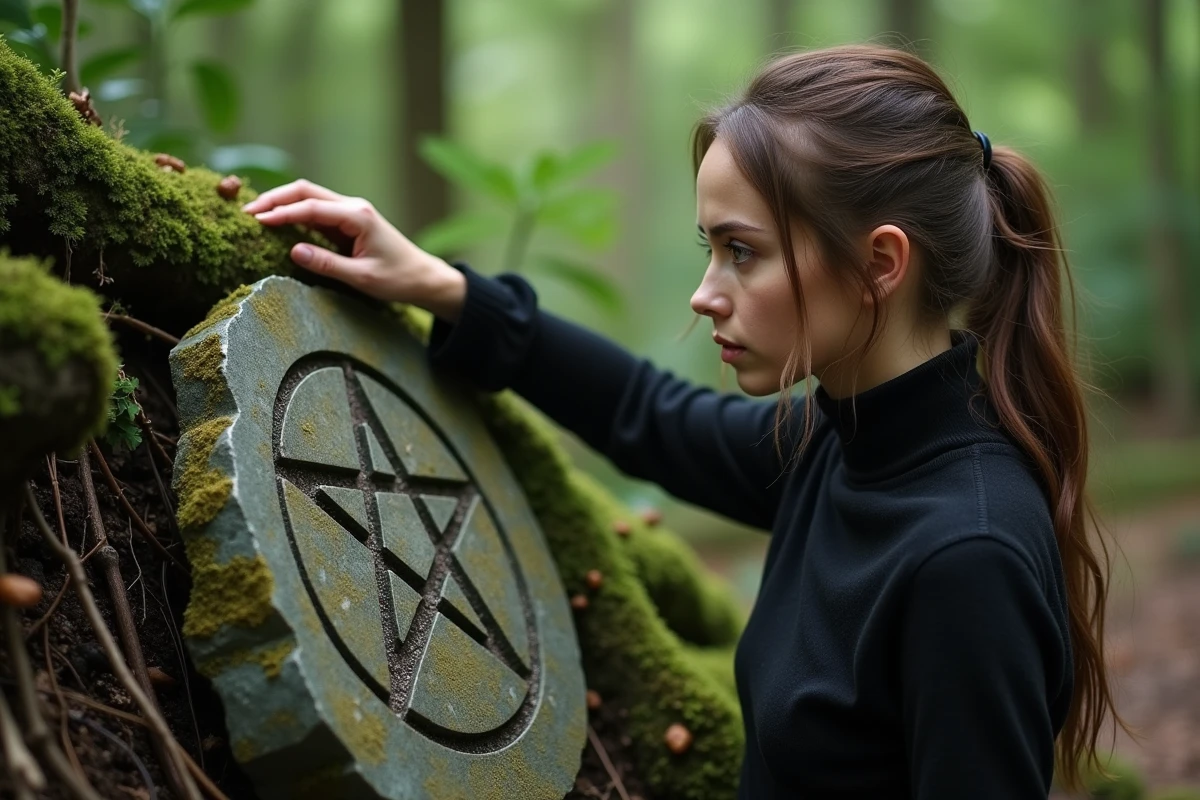
The pentagram between sacred geometry, esotericism, and contemporary perceptions
The structure of the pentagram is appealing both for the regularity of its five branches and for the precision of the points that intersect at the center. This perfection is not limited to an aesthetic whim. Mathematicians, enthusiasts of esotericism and occultism agree on one point: the pentacle is much more than the pretty star one encounters on the back of a notebook; it questions order, chaos, the shadow and light within each being.
According to traditions, the way to represent the pentagram varies. Inserting it into a circle often reinforces its protective aspect and embodies unity, while some attribute to each point a passage along the initiatory path. In ceremonies, the slightest error in the drawing can disrupt the desired outcome: here, magic is a matter of rigor as much as belief.
What strikes in our connected age is that the pentagram has lost none of its ability to disturb. It appears in pop culture, worn as a pendant or showcased on news feeds. Depending on the individual, it becomes a marker of difference or a nod to esotericism, sometimes without fully grasping all that its heritage carries. Nevertheless, it raises questions, sparks debate, and continues, unperturbed, to navigate between opposites. Tomorrow, a new interpretation may arise. The pentagram has not finished blurring the lines.